June 27, 1936: When the USSR Banned Abortion and Women Began to Die
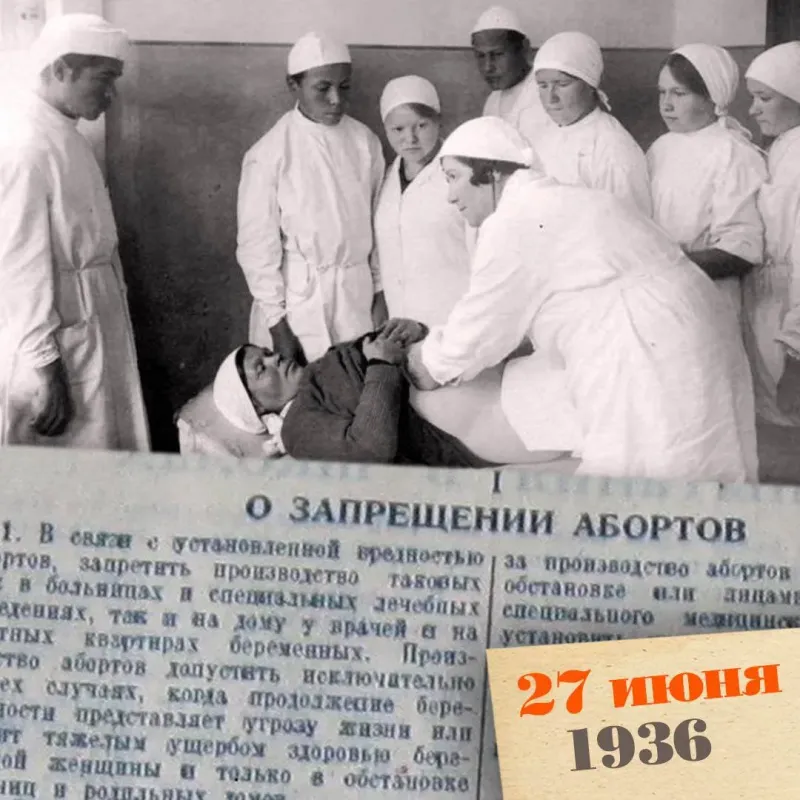
On June 27, 1936, the Central Executive Committee and the Council of People’s Commissars of the Soviet Union adopted a decree banning abortion. The decision marked a dramatic reversal of Soviet policy. Just sixteen years after Soviet Russia became the first country in the world to legalize abortion, the procedure was criminalized once again.
From legalization to prohibition
In November 1920, Soviet Russia legalized abortion through a decree issued by the People’s Commissariats of Health and Justice. The measure was presented as part of a broader effort to protect women’s health and expand women’s rights.
Over the following years, restrictions gradually increased. In 1924, abortions were allowed only under limited circumstances, such as when pregnancy threatened a woman’s life or health or resulted from rape. Some restrictions were relaxed in 1926, but limitations remained, including for first pregnancies and abortions performed shortly after a previous pregnancy. In 1930, abortion services became subject to payment.
By 1936, nearly all abortions were prohibited.
What the law established
The decree banned abortions both in medical institutions and outside them. Physicians faced prison sentences for performing abortions, while harsher penalties applied to individuals without medical training or those carrying out procedures in unsafe conditions.
The only legal exception was when continuing the pregnancy posed a serious threat to the woman’s life.
The official justification and its consequences
Soviet authorities argued that the ban was necessary to address demographic concerns during a period of profound social and political upheaval.
In reality, the prohibition did not eliminate abortions. Instead, illegal procedures increased dramatically. Many were performed in unsafe conditions, contributing to a rise in maternal deaths. At the same time, the government’s goal of substantially increasing birth rates was not achieved.
Women spoke out
Many women wrote letters to Soviet authorities describing the economic hardship and personal circumstances that made another pregnancy impossible. They warned that banning abortion would not stop women from seeking the procedure, but would instead force them to resort to unsafe methods.
Their appeals remained largely ignored for almost twenty years.
The policy reversal
In the 1950s, Soviet policy gradually began to change as the list of medical indications for abortion expanded. In 1955, abortion was decriminalized, effectively ending the criminal prohibition introduced in 1936.
Today, historians frequently cite the Soviet experience as evidence that banning abortion does not eliminate the demand for the procedure, but may instead increase unsafe abortions and maternal mortality.
Source: This article is based on material published by Nemoskva. The original article is available in English: https://nemoskva.net/en/2026/06/27/zapret-abortov-v-sssr-postanovlenie-ot-27-iyunya-1936-goda/